
M3 Closure Highlights Transport Risks at Heart of Hospital Relocation Debate
The closure of a major section of the M3 motorway this week has brought renewed focus to a question central to plans for a new Frimley Park Hospital: how resilient is the surrounding transport network when things go wrong?
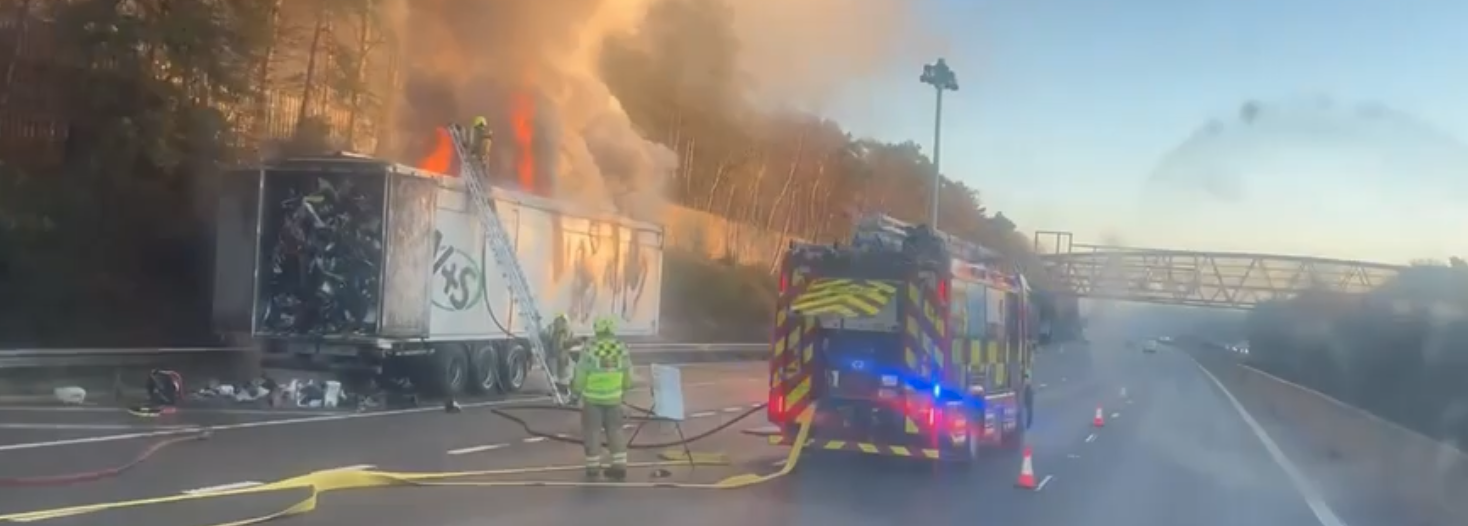
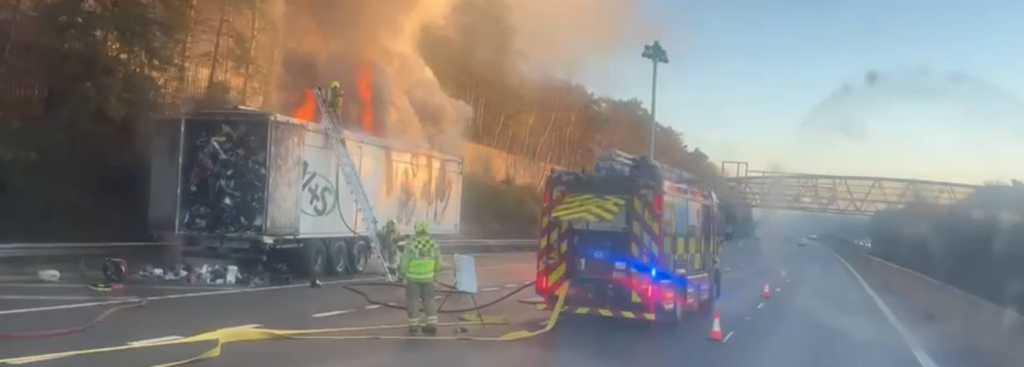
On Wednesday morning, a lorry fire involving mixed electrical waste and lithium batteries forced the full closure of the M3 between Junctions 3 (Lightwater/Woking) and 4 (Farnborough). The incident, which began shortly after 5am, led to delays of up to 90 minutes, widespread congestion on diversion routes through Camberley, Farnborough and surrounding towns, and warnings to residents to keep windows and doors closed due to heavy smoke.
Emergency services remained on scene for several hours as the fire repeatedly reignited, underlining the complexity of incidents involving hazardous cargo and the difficulty of restoring normal traffic flow once the motorway is compromised.
A corridor under pressure
The affected stretch of the M3 sits at the heart of the road network serving Frimley, Heatherside and Deepcut — and would be a critical access route for any relocated hospital in the area.
While incidents of this nature are rare, they are not exceptional. Fires, collisions, breakdowns and unplanned closures occur on the M3 every year, often with disproportionate knock-on effects on surrounding A-roads that are already heavily trafficked during peak hours.
On this occasion, congestion rapidly spread onto the A331, A322 and A30, with local roads becoming gridlocked as diverted traffic attempted to bypass the closure.
For residents, the disruption was frustrating. For planners and decision-makers, it raises a more serious question: how would a hospital dependent on this corridor function during similar incidents?
Implications for emergency access
Hospitals rely on predictable, resilient access — not just on average days, but on the worst days. Ambulances, staff, patients and supplies must all be able to reach the site quickly and reliably, even when major transport arteries are compromised.
Wednesday’s closure demonstrated how quickly:
- Motorway access can be lost entirely
- Local roads can become saturated within minutes
- Visibility and air quality can deteriorate
- Emergency traffic management can be halted for safety reasons
In this case, National Highways and Surrey Fire and Rescue were forced to stop releasing trapped traffic at points due to visibility concerns caused by smoke — a reminder that not all disruptions are easily mitigated.
Planning for failure, not perfection
Supporters of relocating Frimley Park Hospital have argued that proximity to the motorway provides strong connectivity. Critics counter that connectivity without resilience is a risk, particularly when alternative routes are limited and already overstretched.
The M3 incident illustrates the importance of stress-testing assumptions about access and infrastructure. A hospital site must be evaluated not just on normal operating conditions, but on:
- Partial or full motorway closures
- Hazardous incidents requiring prolonged response
- Peak-time congestion combined with unplanned disruption
- The cumulative impact on surrounding residential roads
These are not hypothetical scenarios — they are lived realities for communities along the M3 corridor.
A reminder amid wider scrutiny
The closure comes at a time when the proposed relocation of Frimley Park Hospital is already under intense scrutiny, particularly around infrastructure readiness and whether associated upgrades have been fully costed and planned.
Recent correspondence from local representatives has raised concerns that road and transport improvements required to support a new hospital have yet to be fully budgeted. Events like Wednesday’s closure inevitably sharpen those concerns.
Learning the right lessons
No single incident should determine the fate of a major infrastructure project. But equally, no major infrastructure project should ignore clear evidence of how its supporting systems behave under pressure.
The M3 closure serves as a timely reminder that access is not just about proximity, but reliability — and that decisions with generational consequences must be informed by real-world conditions, not best-case assumptions.
As plans for a new hospital continue to evolve, the question for planners and ministers alike is whether the transport network surrounding any proposed site can truly support a critical national asset — not just when everything is working, but when it isn’t.
January 2026 – J3–J4 (Lightwater / Farnborough / Camberley)
A lorry carrying mixed electrical waste, including lithium batteries, caught fire in the early hours of the morning.
The M3 was fully closed for several hours, causing delays of up to 90 minutes, widespread diversion onto local roads, poor air quality, and visibility concerns that halted traffic relief efforts.
Autumn 2025 – J4A (Farnborough / Camberley)
Multi-vehicle collision during peak hours led to lane closures and significant congestion extending onto the A331 and A30, with knock-on delays through Camberley and Bagshot.
Summer 2025 – J3 (Bagshot / Lightwater)
Breakdown and recovery of a heavy goods vehicle resulted in partial carriageway closure and prolonged stop-start traffic, with diversion routes quickly becoming saturated.
Spring 2025 – J6 (Hook / Bracknell)
Emergency roadworks following a vehicle fire caused severe delays during the morning commute, impacting traffic flows toward Bracknell, Hook and surrounding feeder roads.
Ongoing pattern
National Highways data shows that incidents on the M3 — including collisions, vehicle fires, breakdowns and unplanned closures — routinely result in disproportionate congestion on surrounding local roads, particularly through Camberley, Bagshot, Bracknell and Farnborough, where alternative routes are limited.
I


Leave a Reply