
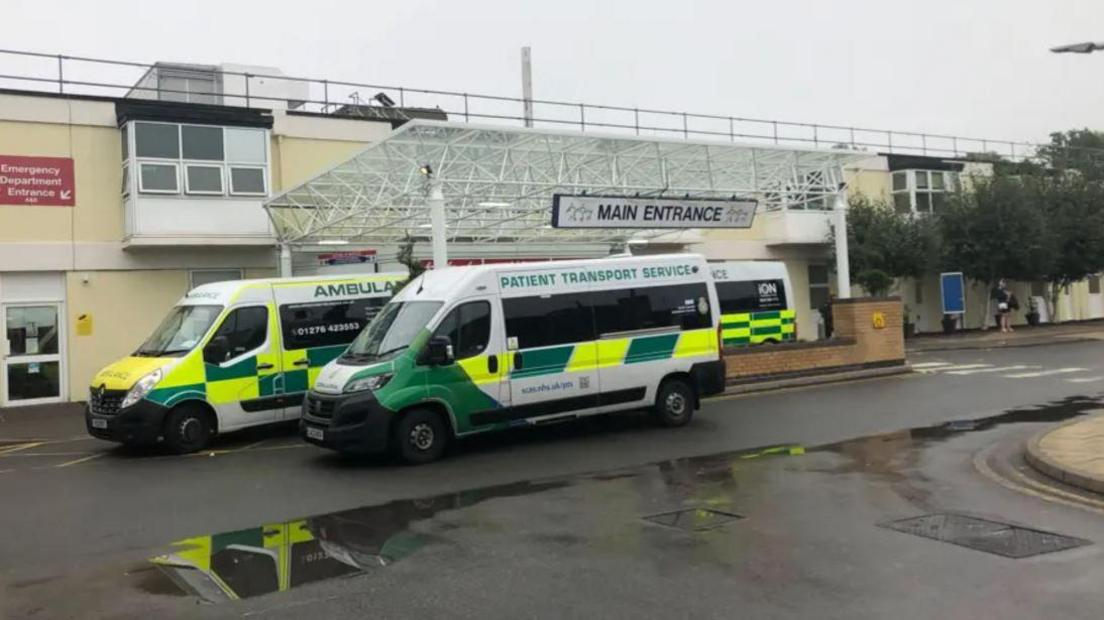
Here’s a newspaper-style article draft using the FOI response as the hook, with a sharp angle but careful wording.
DID ANYONE ASK THE AMBULANCES?
Frimley Health admits it holds no recorded evidence of formal ambulance service input on new hospital site selection
If you were planning a major new hospital with an A&E department, one of the first questions most people might ask is obvious: what do the ambulance services think of the location?
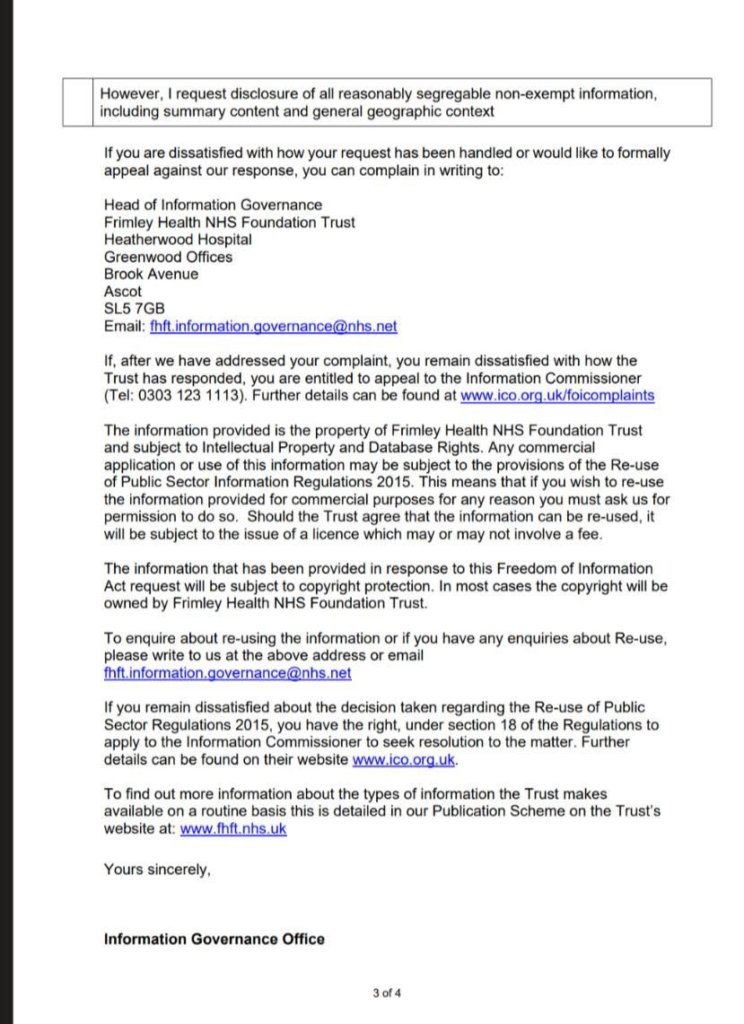
But a Freedom of Information response from Frimley Health NHS Foundation Trust has raised serious new questions about whether that basic step was properly recorded during the site selection process for the proposed new Frimley Park Hospital.
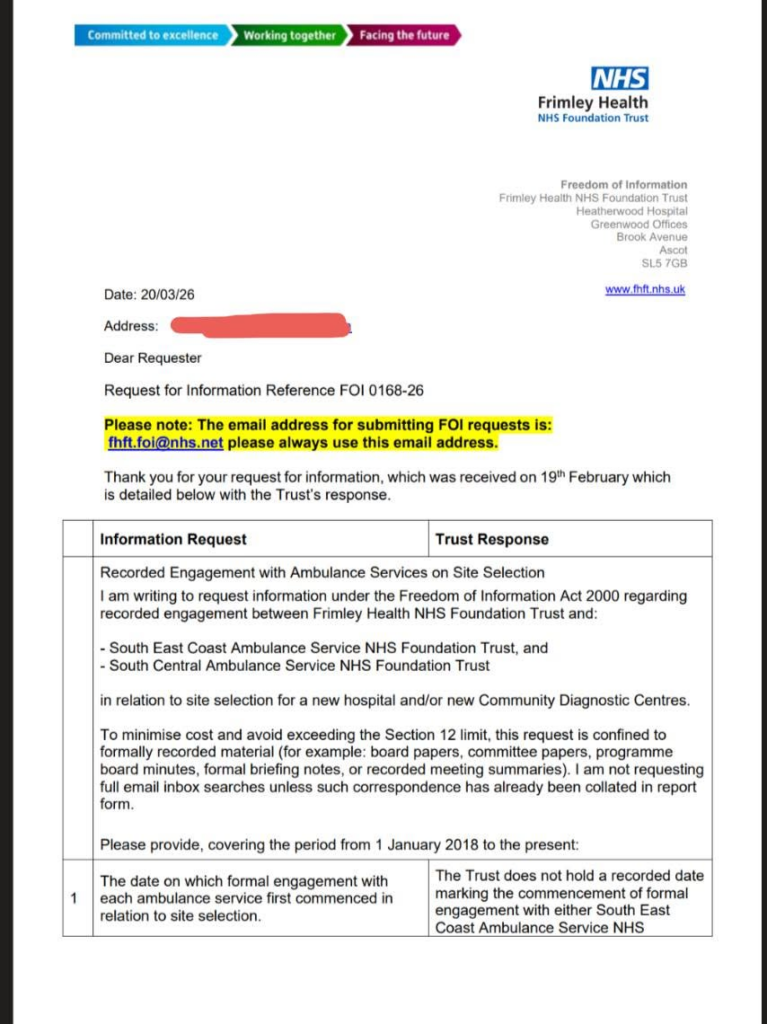
In response to an FOI request asking for recorded engagement with South East Coast Ambulance Service and South Central Ambulance Service in relation to site selection, the Trust said it does not hold a recorded date marking the start of formal engagement with either ambulance service.
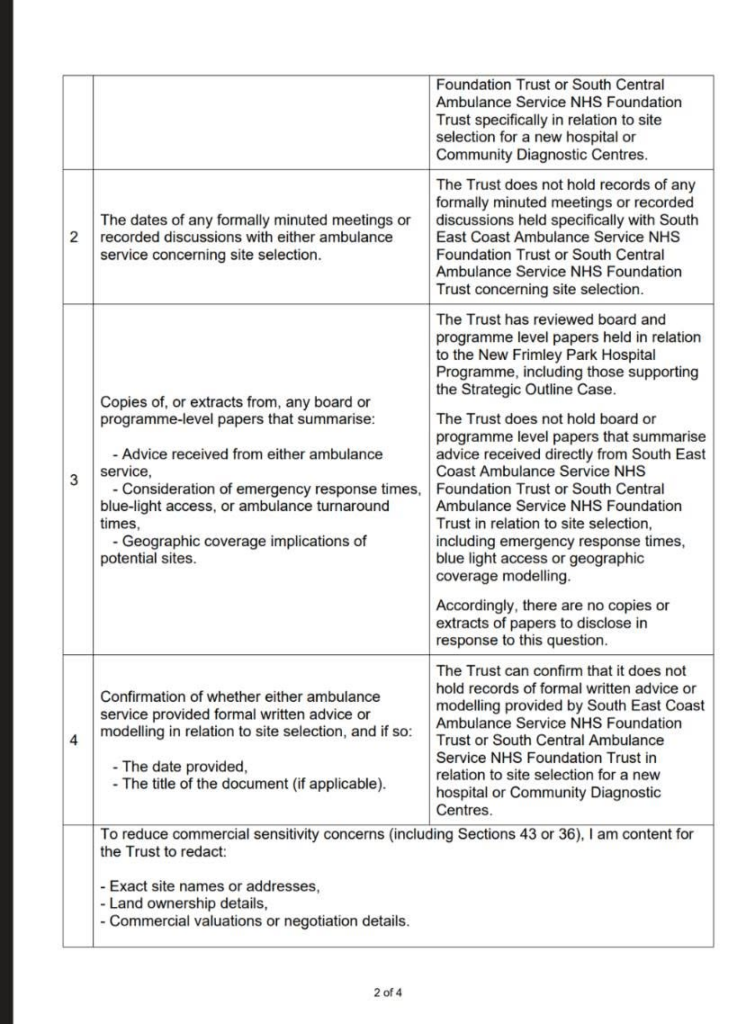
Even more strikingly, the Trust said it does not hold records of any formally minuted meetings or recorded discussions with either ambulance service specifically concerning site selection.
The request also asked for copies or extracts from board or programme-level papers summarising advice from the ambulance services, including issues such as emergency response times, blue-light access, ambulance turnaround times and the geographic implications of potential sites.
Again, the Trust said it does not hold board or programme-level papers summarising advice received directly from either ambulance service in relation to site selection.
That is an extraordinary gap.
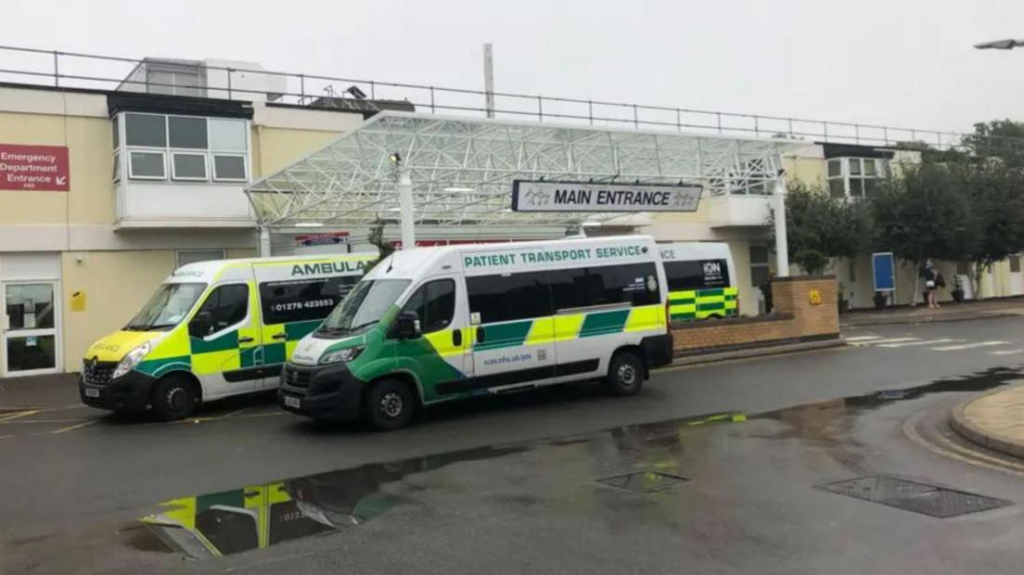
This is not a request about paint colours, car parking layouts or signage. This is about the location of a major hospital with emergency care. Ambulance access should surely be one of the most important parts of the decision.
Residents are already deeply concerned about the preferred Frimley Fuel Allotments site, particularly around road access, traffic congestion, construction disruption and the suitability of the surrounding network.
The proposed site has been heavily criticised by local people who fear that already busy roads could become overwhelmed by hospital traffic, staff journeys, patient visits, deliveries, emergency vehicles and years of construction movements.
The FOI response does not necessarily prove that ambulance services were never spoken to. But it does appear to show that Frimley Health does not hold formal records of direct ambulance advice, formal meetings, or written modelling from the ambulance services specifically about site selection.
That matters.
If ambulance response times, blue-light routes and emergency access were considered, where is the evidence? Who provided it? Was it independently assessed? Was it modelled? Was it reviewed before the preferred site was chosen?
And if the ambulance services were not formally asked for written input on the location, why not?
The Trust has repeatedly said the Frimley Fuel Allotments site is the only viable option for the new hospital. But the public is still waiting for the full site appraisal, scoring matrix and rejected-site evidence to be published.
Now this FOI response adds another troubling question: how can the public have confidence in the preferred site if there is no recorded ambulance service advice on the very issues that matter most to emergency access?
The issue is especially important because residents have been told the site was selected after careful assessment of alternatives. Yet if such a critical stakeholder group has not left a clear paper trail in that assessment, the process risks looking incomplete at best and careless at worst.
A new hospital may well be needed. Frimley Park has serious structural challenges and local people understand the importance of modern healthcare facilities.
But choosing the wrong site for a hospital could create problems for generations.
Before this process goes any further, Frimley Health should publish the full evidence behind the site decision, including any emergency access modelling, ambulance route analysis, blue-light journey assessment and all engagement with ambulance services.
If those records exist elsewhere, they should be released.
If they do not exist, residents deserve to know why.
Because when a hospital site is being chosen, “did anyone ask the ambulances?” should not be a difficult question to answer.




Leave a Reply